- Region
- Above Souda Bay, Apokoronas
- Distance
- About 15 km east of Chania
- Highlights
- Theatre, Roman cisterns, monastery
- Visit
- 1–2 hours
A powerful city
Aptera controlled Souda Bay through two ports, Minoa at today's Marathi and Kisamos at today's Kalyves. It minted its own coins, and its archers served as mercenaries abroad.
A strong earthquake in the 4th century AD caused heavy damage, and another in the 7th century ended the city.
What to see
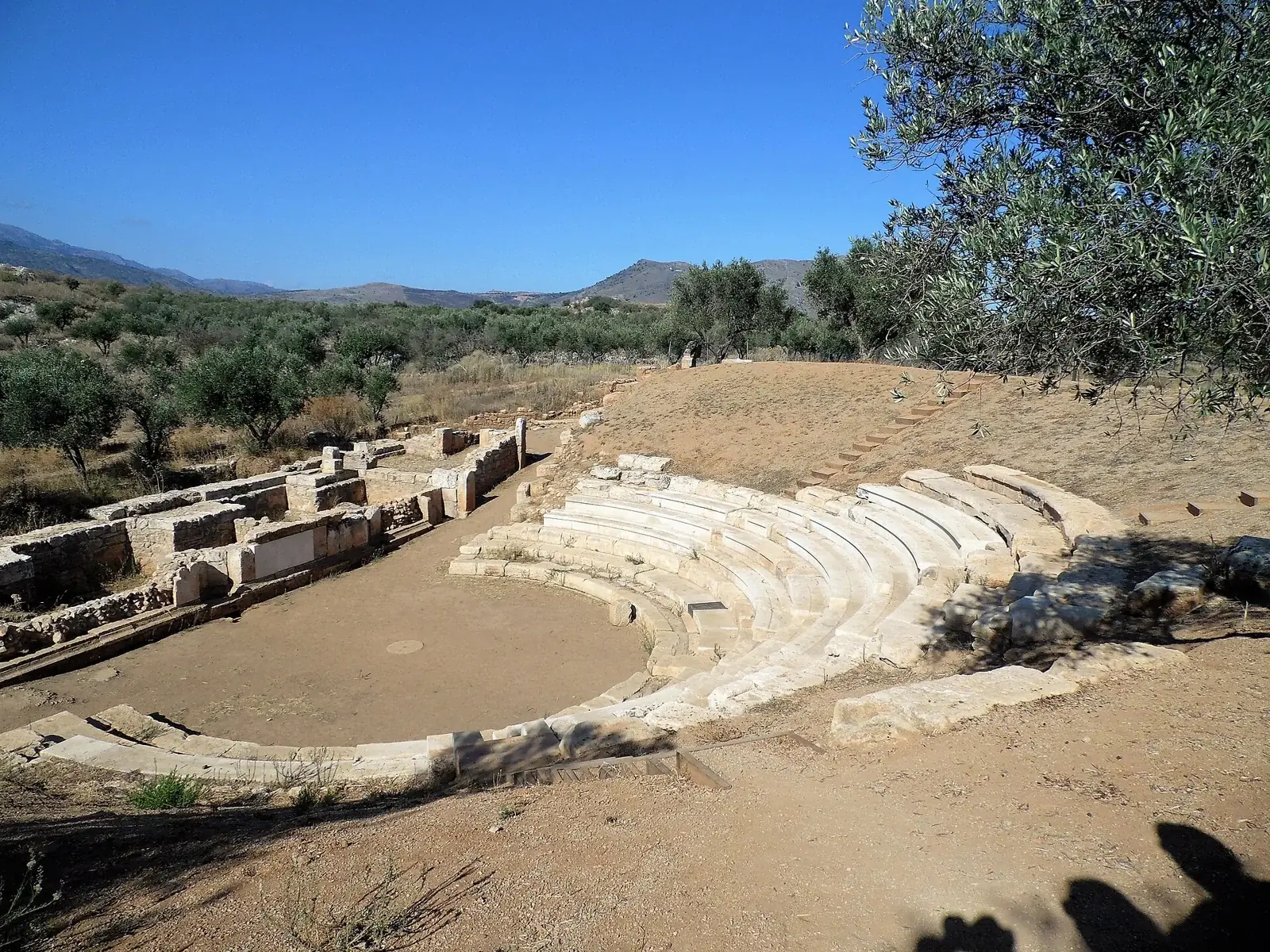
The theatre was built in three phases from the Hellenistic to the Roman period, seated an estimated 3,700 people and faces the White Mountains. Its orchestra, with a radius of 5.45 m, is one of the smallest known. Beside it runs a paved Hellenistic street about 55 m long.
The two Roman cisterns are the most impressive structures: huge vaulted reservoirs that fed bath complexes further north, and the largest public works of the Greco-Roman city. In the centre stands the monastery of Agios Ioannis Theologos, mentioned in a chronicle of 1181.
The name
Legend says the Muses defeated the Sirens in a singing contest here. The losers lost their wings, which fell into Souda Bay and became its small white islands, and the city was called Aptera, 'without wings'.
Practical tips
Bring water and a hat: the site is exposed. Only the toilets are adapted for visitors with reduced mobility. On the hill stands the Koules, a small Ottoman fort built after the 1866 revolt; it is separate from the larger Izzeddin fortress, built in 1872 on the shore below at Kalami.
Questions before you go
How old is Aptera?
It appears on Linear B tablets of the 14th century BC and was inhabited until the 7th century AD.
What is the most impressive part of Aptera?
For most visitors, the huge Roman cisterns and the theatre facing the White Mountains.
Why is it called Aptera?
From a legend that the Sirens lost their wings here after losing a contest to the Muses.