Walking Through Chania Old Town: A Neighborhood-by-Neighborhood Guide
Chania’s Old Town is not one place — it’s several, layered on top of each other across five thousand years. Venetian mansions sit beside Ottoman minarets. A synagogue and a mosque are a two-minute walk apart. You can start your morning at a harbor built in the 1300s and end it in a backstreet where a man still makes leather boots by hand. All of it fits inside an area you could cross in fifteen minutes — if you didn’t keep stopping to look.
What makes the Old Town of Chania special isn’t any single monument. It’s the density of history packed into a small, walkable space, and the fact that it’s still very much a living city. People live here, eat here, argue about parking here. The cats outnumber the tourists in winter, and the narrow streets smell like jasmine and grilled octopus in equal measure.This guide walks you through the Old Town neighborhood by neighborhood, roughly in the order you’d encounter them on foot. You don’t need a map — getting a little lost is part of the experience — but knowing what you’re looking at makes the walk a lot richer.The Venetian Harbor
Start here. Everyone does, and for good reason. The harbor was built by the Venetians in the 14th century, and it remains the emotional center of the city. The waterfront curves in a wide arc from the Firka Fortress on the west to the old shipyards on the east, lined with restaurants, cafes, and colorful two-story buildings that reflect in the water at night.A few things worth knowing as you walk along it:The Egyptian Lighthouse stands at the end of a long stone breakwater on the harbor’s eastern arm. It’s called “Egyptian” because it was rebuilt by Egyptian troops in the 1830s during a brief Egyptian occupation of Crete, but the original structure was Venetian, dating to around 1570. It’s one of the oldest lighthouses in the world. The walk out to it takes about ten minutes and gives you the best panoramic view of the harbor and the White Mountains behind the city. Go at sunset if you can.The Mosque of the Janissaries (Küçük Hasan Mosque) sits right on the waterfront, impossible to miss with its distinctive domed roof. It was built in 1645 — the year the Ottomans captured Chania — making it the oldest surviving Ottoman building on the island. It’s no longer a functioning mosque; today it hosts occasional exhibitions and art shows.The Venetian Shipyards (Neoria) line the eastern side of the harbor — a row of long stone buildings with arched entrances, originally used to store and repair Venetian warships. Several of the original arsenals survive. The largest, the Grand Arsenal, now houses the Mediterranean Architecture Center. Another serves as the headquarters of the Sailing Club of Chania — one of the most atmospheric spots in town for a morning coffee with a harbor view. In one of the smaller arsenals, you can see a replica of a Minoan merchant ship that sailed to Athens for the 2004 Olympic opening ceremony.Firka Fortress, on the western end of the harbor, was built by the Venetians shortly before the Ottoman conquest. Its most important moment came much later: on December 1, 1913, the Greek flag was raised here for the first time, marking Crete’s union with Greece. Today the fortress houses the Maritime Museum of Crete. Even if you skip the museum, walk up to the top for the view.The Neighborhoods
The Old Town is made up of several neighborhoods, each shaped by the people who lived there. After the Ottoman conquest in 1645, the city was effectively divided: the Turks moved into the wealthier eastern parts (Kastelli and Splatzia), while the Greek Christians were pushed west into Topanas. The Jewish community occupied a small area between them. These divisions are long gone, but the character of each neighborhood is still distinct.Topanas — The Christian Quarter
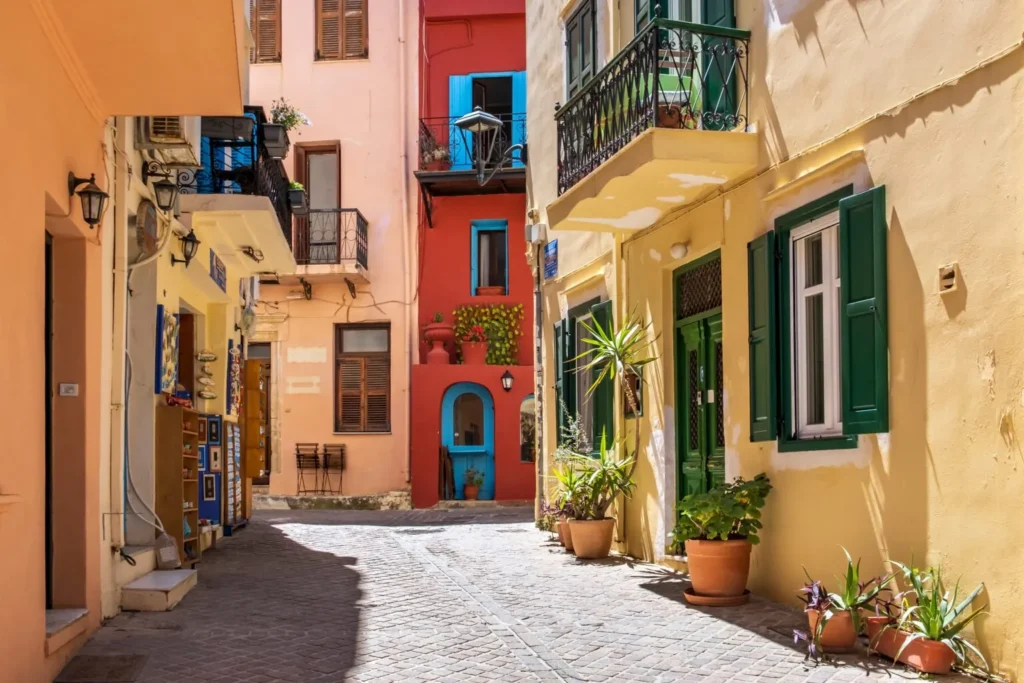
Just behind the Firka Fortress, Topanas is where the Greek Orthodox population lived during the Ottoman centuries. Its name comes from the Turkish word tophane — an ammunition depot that once stood on Theotokopoulou Street. That same street is now the neighborhood’s main artery: a narrow, photogenic lane of restored Venetian mansions, many of them converted into boutique hotels, art galleries, and souvenir shops.Walk down Angelou Street and the small alleys branching off it for a quieter, more residential side of Topanas — bougainvillea spilling over old stone walls, cats asleep on doorsteps, the occasional glimpse of the sea between buildings. The San Salvatore Convent, built in the 15th century and later turned into a mosque, now houses the Byzantine and Post-Byzantine Collection of Chania.At the junction of Zambeliou and Douka streets, you’ll find the remains of a Turkish bathhouse — one of several hammams that once served the Ottoman city.Evraiki — The Jewish Quarter
Tucked between Topanas and the harbor, the Jewish quarter (Evraiki or Ovraiki) is small, roughly bounded by Zambeliou, Portou, Halidon, and Skoufon streets. Kondilaki Street was its main road, wider than most Old Town lanes because carriages once passed through — the wealthier Jewish families lived here.The community’s roots go back centuries. Sephardic Jews, expelled from Spain in 1492, were invited by the Ottoman Sultan to settle in cities across the empire, including Chania. They built a small but close-knit community here that lasted until World War II. In May 1944, the Nazis arrested the entire Jewish community of Chania. They were transported to Heraklion and loaded onto a ship. A British submarine torpedoed it off the coast, and everyone on board was lost.The Etz Hayyim Synagogue, on a quiet side street off Kondilaki, was restored in the late 1990s and reopened in 1999. It’s the only surviving synagogue on the island of Crete. You can visit it — the small interior courtyard is peaceful and quietly powerful. It functions both as a memorial and an active place of worship.Kastelli — The Oldest Hill
The low hill directly behind the harbor is Kastelli, and it is the oldest continuously inhabited part of Chania. People have lived here since the Neolithic period — over 5,000 years. This was the site of ancient Kydonia, one of the most important Minoan cities, and later became the center of Byzantine and Venetian Chania.Today Kastelli is quieter than the surrounding neighborhoods, a little more residential, a little less polished. You can still see parts of the Byzantine fortification wall, and ongoing excavations occasionally reveal Minoan-era remains beneath the streets. The main square at the western base of the hill is Eleftherios Venizelos Square, commonly called Syntrivani (from the Turkish word for “fountain”) — the central meeting point of the Old Town.Splatzia — The Turkish Quarter
East of Kastelli lies Splatzia, where the Ottoman elite once lived. Officially renamed “1821 Square” in honor of the Greek Revolution, locals still call it Splatzia. The large plane trees shading the square, the scattering of tavernas, and the relaxed pace make it one of the most pleasant spots to sit and do nothing for a while.The Church of Agios Nikolaos here tells the story of the whole city in one building. It was originally built in the 1320s as a Dominican monastery. The Ottomans converted it into a mosque and added a minaret. After Greek independence, it became an Orthodox church again. Today it’s one of the only churches in Greece with both a bell tower and a minaret — a quiet architectural reminder of everything this city has been through.The streets around Splatzia — particularly Daliani Street — come alive in the evening. This is where many Chanians go for a night out: small restaurants and mezedopoleia set tables in the alleys, wine flows, and on good nights, someone brings a lyra.Halidon Street & Skridlof Street
Halidon Street is the Old Town’s main commercial artery, a wide pedestrian road that runs from the modern city down to the harbor. You’ll pass the Trimartiri Cathedral (Chania’s main Greek Orthodox church), the Archaeological Museum — housed in a former Franciscan monastery that was later turned into a mosque — and dozens of shops, from traditional craft stores to the usual tourist fare.Just off Halidon, look for Skridlof Street, also known as “Leather Lane” or Stivanadika. For generations, this narrow lane was where Chania’s bootmakers made stivania — the tall, stiff leather boots that are part of the traditional Cretan male costume. Very few artisans still make them by hand, but you can still see workshops alongside shops selling leather sandals, bags, and belts. The smell of leather hits you before you see the stalls.Continuing past Skridlof leads you to the back of the Municipal Market building. On Sifaka Street, nearby, you’ll find macherádika — the traditional Cretan knife-makers, another craft that has survived in these streets for centuries.The Municipal Market (Agora)
Koum Kapi & Tabakaria
If you walk east from the harbor, past the old Venetian walls, you’ll enter Koum Kapi — the name comes from the Turkish for “sand gate,” referring to one of the bastion gates in the fortification wall. It was one of the first areas to develop outside the old walls and is now a stretch of waterfront bars, cafes, and a small sandy beach popular with locals.A bit further east along the coast is Tabakaria, the old tannery neighborhood. In the 19th and early 20th century, this is where animal hides were processed — you can still see the ruined shells of old tannery buildings along the waterfront. Once run-down and forgotten, the area has been slowly transforming into one of the trendiest parts of Chania, with a handful of excellent restaurants and a very different mood from the Old Town proper.Halepa
Further east still — about a 25–30 minute walk from the harbor, or a quick cab ride — is Halepa, the aristocratic neighborhood where European consulates and wealthy Cretan families built their grand homes in the 19th century. This is where Eleftherios Venizelos had his residence (now a museum), and where much of Crete’s political history was shaped — most notably the signing of the Treaty of Halepa in 1878, which granted Crete partial autonomy from the Ottomans. It’s quieter, greener, and more elegant than the Old Town — a nice contrast if you’ve been in the narrow lanes all morning.Practical Tips
- Time needed: You can see the main highlights in 3–4 hours, but a full day lets you slow down and actually enjoy it. Two evenings at the harbor are better than one.
- Best time to walk: Early morning (before 9 AM) for photos with no crowds and soft light. Late afternoon into evening for atmosphere — the harbor at sunset is why half the photos of Chania exist.
- Shoes: Wear comfortable ones. The streets are cobblestone and uneven, and you’ll walk more than you think.
- Parking: If you’re driving, the most convenient lots are at Chania Port Parking (east side) or the lot behind Firka Fortress (west side). Arrive early in summer.
- Getting there: Chania Old Town is about 15 km (20–25 min) from Chania Airport by car.
- Eating: Avoid the waterfront restaurants directly on the harbor — they’re overpriced and tourist-oriented. The best food is usually one or two streets back, in the alleys of Splatzia, Topanas, or around the Jewish Quarter. Ask a local, or follow the Greeks.
- Skip the map: Seriously. The Old Town is compact enough that getting lost always leads somewhere interesting, and you’ll find your way back to the harbor eventually.
One Last Thing
Chania’s Old Town gets compared to a lot of places. People call it “the Venice of Greece” or “a little Istanbul.” These comparisons are flattering but not quite right. Chania doesn’t feel like anywhere else. It has the Venetian bones, the Ottoman layers, the Greek heart, and a Cretan stubbornness that refuses to let any of it be turned into a museum piece. People still live here, still hang laundry over streets that were built five hundred years ago, still argue with their neighbors over whose cat is whose.That’s what makes walking through it worth your time. Not the monuments — though they’re remarkable — but the feeling that you’re walking through a city that has been lived in, fought over, rebuilt, and loved for a very long time, and that somehow, against all odds, is still doing all of those things at once.🚗 Car Rental in Crete — Best Local Prices, Island-Wide Delivery
Explore the whole island of Crete at your own pace. We deliver your rental car wherever you are — airports, ports or your hotel — across all of Crete.
- ✅ Chania Airport & Heraklion Airport — fast pickup, no queues
- ✅ Chania Port & Heraklion Port — car ready when your ferry arrives
- ✅ Hotel delivery anywhere in Crete — Chania, Heraklion, Rethymno, Agios Nikolaos
- ✅ Economy to 9-seaters — manual, automatic, SUV available
- ✅ Free cancellation — book with confidence
Get Your Free Car Rental Quote — Delivered Anywhere in Crete
🚗 Get Free Quote — Car Hire CreteNo credit card required • Instant quote • All airports, ports & hotels
Local tip: As a local car rental company based in Chania, Crete, we deliver island-wide — airports, ports and hotels. The car rental link supports our site at no extra cost to you.